
Hair as a Weapon and the Mermaids who Wield it
The common mermaid perception of luring men to their death, was partly made possible because of the way their hair was depicted. Mermaid’s hair functioned as a weapon of lust and enticement, and that depiction was used as a way of controlling and oppressing women in the Middle Ages by showing women’s sexuality as evil and dangerous. Why was hair the symbolic weapon and how was that perception used to control and oppress? What can be learnt from this? How did mermaid hair come to be what it is today?
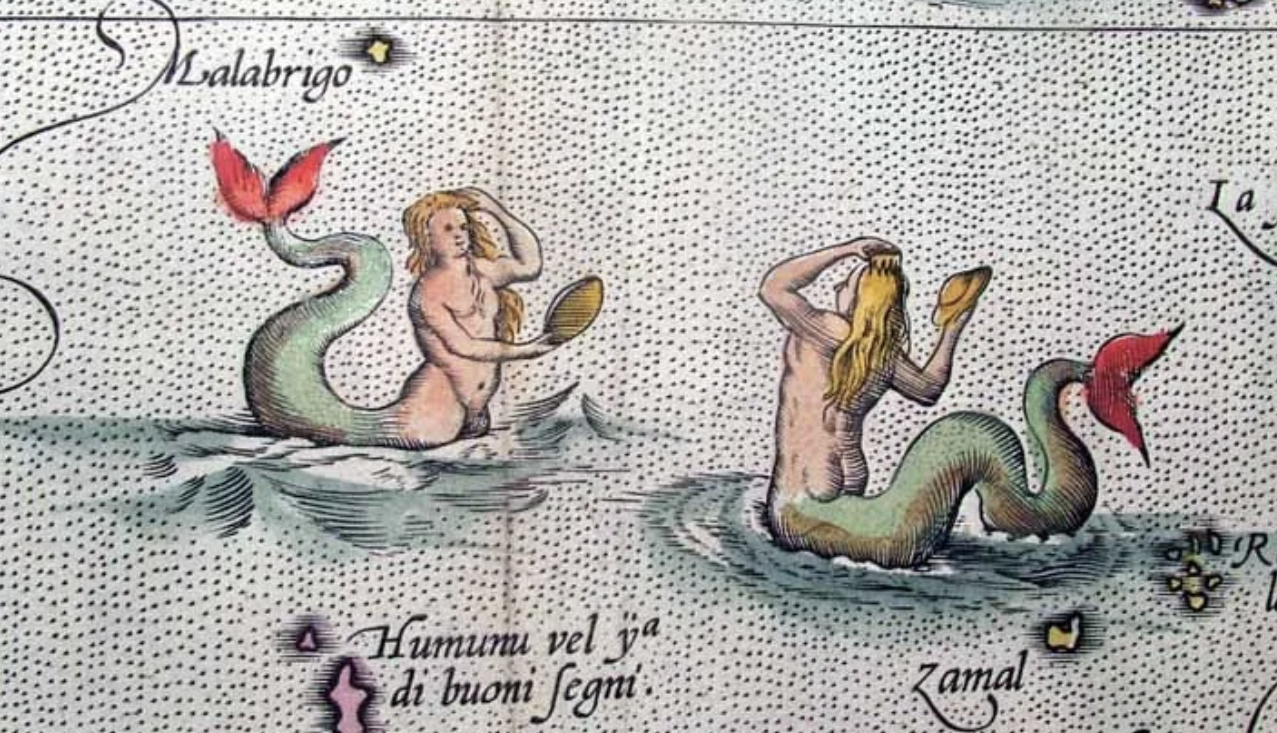
The myth of the mermaid has existed all over the world, in many different cultures: sometimes they were kind and benevolent, sometimes they were evil and dangerous. Their use in storytelling adapted to whatever the story needed. It is believed that the first mermaid type creature was the God ‘Ea’ or ‘Oannes’ who was originally worshipped in Akkad as early as 5000-4000 B.C. He was mostly described as having the tail of a fish but sometimes shown as completely human and was later adopted by the Babylonians where he became the Lord of the Waters, and one of the great triad of Babylonian gods. Even though this is the first evidence we have of mermaid type creatures in mythology, I find it hard to believe this was actually the first as mermaid myths have been prevalent throughout human history.
It was Europe during the Middle Ages where mermaids became known as the lustful, dangerous beings who would lure unsuspecting men to their death. The rise of Christianity had a huge impact on its mythology and storytelling. There was a move from nuanced understandings of myths into good vs. evil stories. They combined the myth of the mermaid with the Greek myth of the Siren who were described in Homer’s Odyssey as half-bird/half-woman who’s voice lured sailors to their death. This combination created a cultural understanding in Medieval Europe of mermaids as beautiful women who, with the bottom half of a fish, sing songs to entice men with the promise of sex and then kill them, either by drowning them or causing shipwrecks. But it wasn’t just their song that was enticing, it was also that they were beautiful and their beauty was dangerous.
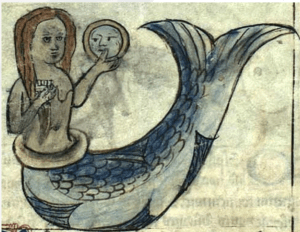
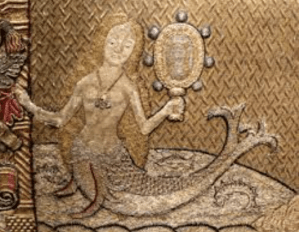
It’s during this period where we start to see depictions of mermaids looking in the mirror and combing their hair. The mirror and the comb represent vanity and vanity, according to Christianity, is one of the deadly sins, therefore, in these depictions the comb and mirror represent sin, and in turn, so does their hair. This is when the mermaid’s hair becomes a weapon, it’s a weapon of sin, a tool to bring down good Christains. The mermaid tale, then became a cautionary tale: Mediaeval Christian churches would exaggerate the sexual aspects of mermaids, linking sexual temptations as the cause of the destruction of man.
To add to this, the idea of the comb and mirror brings in the sense that it’s not just that mermaids are naturally beautiful and lustful, but that they are intelligent beings that are actively manipulating. It was believed that mermaids would use their long hair to conceal their bodies, ‘imitating coy façades as sailors gaze at their barely covered bodies in admiration and hunger for a glance at the flesh beneath the hair.’1 Once they had the sailor’s attention, they would move their hair and reveal their bodies to fully entice them. Just as their hair could be used as a weapon it could also be used as a shield. As Krista Lauren Gilbert writes in The Mermaid Archetype:
‘If wielding hair can be equated to wielding a powerful weapon, then her weapon is double-edged and paradoxical. As both shield and blade, her hair simultaneously protects, incites, and ferociously attacks. As shield her hair acts as clothing in the realm of consciousness. Like Botticelli’s Venus emerging from the sea, her long tresses hold the numinous power selectively and protectively to conceal and reveal the beauty that lies beneath’2
What can be learnt from this?
The idea of hair being both blade and shield still feels relevant today. There are so many of us who use our hair to blend in, to not be noticed – I know that’s true for myself. Most of my life I’ve wanted hair that doesn’t draw too much attention to me – for a long time as a child I just wore my hair in a ponytail because that felt like a good compromise between the social norms of having long hair, and having the sensory need to keep it out of my face . It wasn’t until I came out as queer that I started cutting my hair short and, every now and then, shaving my head. Before I was using my hair as a shield, a way to fit in, but accepting my queerness was the instigator to start using my hair as a weapon. I used to know a lot of people that hated my shaved head, and their hate made me want to keep shaving my head more. It felt exciting to be so provocative just through the way I was wearing my hair. These days I mostly wear a hat because of my sensory needs but every time I shave my head I think about those people who hated me doing it and I feel so empowered. Hair doesn’t have to be a weapon that you use all the time, but it’s nice to have it in your arsenal.
How did mermaid hair come to be what it is today?
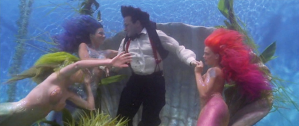
‘Mermaid hair’, nowadays, is a specific style. It is dyed blues, greens, pinks and purples (often in pastels) and styled in beachy waves. Though there are writings of mermaids having green hair within mythology, the first cultural depiction that I have found of mermaids having brightly coloured hair is from the film Hook (1991). In this film there is a mermaid with pink hair, one with blue hair and one with green hair. Since then with the growing popularity of mermaid-ing as a lifestyle, has solidified the mermaids as kind and benevolent and their aesthetic being very colourful.
Modern day understanding of mermaids is very different from the Mediaeval understanding but there’s a power that I think can be learnt from them. Sometimes it can be scary to try something new with your hair because you don’t know if it’ll ‘suit’ you or not, but I argue that it can be less about what you think others think about it, and more about the power you can access with it. A good haircut is a powerful tool and we should all be allowed to harness it.
Research
- Idealizing the Bodies of Medieval Mermaids: Analyzing the Shifted Sexuality of Medieval Mermaids in the Presence of Medieval Mermen by Chloe Victoria Ruby Crull
- Mermaids and Their Cultural Significance in Literature and Folklore by Lara Renee Knight
- Maidens of the Sea: Exploring the Histories of Mermaids, Mami Wata and Yemaya by Franchesca Noemi Guzman
- The Mermaid Archetype by Krista Lauren Gilbert
- The Motif of the Mermaid in English, Irish, and Scottish Fairy- and Folk Tales by Stephanie Kickingereder
- A Cultural History of Hair in the Middle Ages edited by Roberta Milliken
- A Mermaid’s Tale: The Evolution of the Representation of Mermaids in Popular Culture by Melissa Jones
 BuzzGill