
Coiffure à la Titus
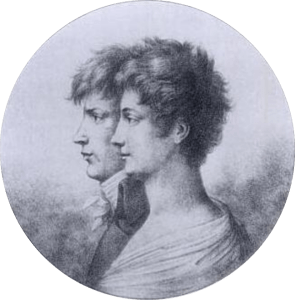
I find hair so interesting! One of the things I particularly love about researching hair throughout history is seeing how styles repeat. Even the hairstyle that I am going to present to you today, is a repeat of a haircut from over a thousand years before!
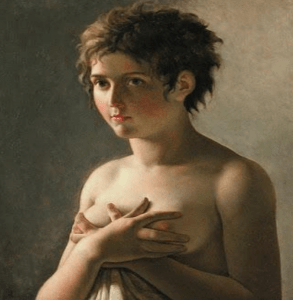
The hairstyle in question is Coiffure à la Titus, or the Titus cut. This cut became popular in France in 1791 with the revival of Voltaire’s play Brutus (1730), a play about the first Roman Consul Brutus, and the eventual execution (by his own hand) of his son, Titus (sorry for the 294 year old spoiler!) In 1791, France was smack bang in the middle of the French Revolution, the extravagance of the bourgeoisie clashed with the economic depression experienced by the majority and an uprising ensued. This play’s resurgence at this time has an almost ‘Make America Great Again’ quality; Brutus himself overthrew the Roman monarchy and instated a republic in its place, and over a thousand years later, France was in the process of doing the same. One of the ways the bourgeoisie had presented their wealth (pre-revolution) was through their extravagant hair (think Marie Antoinette’s pouf). It took a lot of time and money in order to achieve these styles, so once the revolution was in full swing, big, elaborate hairstyles were a sign of the past. That’s where Brutus comes in, or more importantly, Titus.
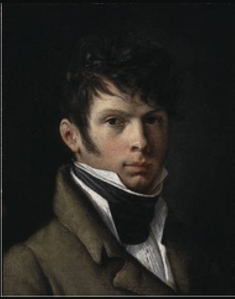
When the play was revived in 1791, the actor that played Titus, François-Joseph Talma, had his hair cut short with the purpose of recreating the visual presence of Ancient Roman emperors. Many French Republican men began to see this short, sort-of dishevelled, hair as in opposition to the monarchy and therefore a symbol of rebellion towards the ruling French aristocrats. The hair was characterised by a short back, a shaggy fringe and length in front of the ears, often called ‘Spaniel Ears’. The hair was usually curly, or artificially curled, at the front, but there are many portraits of the Coiffure à la Titus being worn on straight hair.
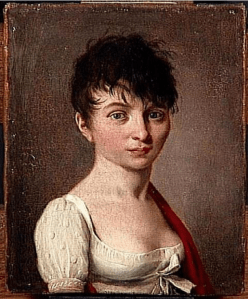
It’s unknown as to when or really why women started to wear this hair because, well, patriarchy means that we don’t often hear from the women themselves, but many scholars see this co-opting of the hairstyle as a kind of ‘fuck you’ to the Republican men who wore this hairstyle and thought of themselves as liberators. The French Revolution did not do much to liberate women and I can imagine a lot of these women felt pissed and lied to.
‘What had been intended as a signifier of male devotion to a Republican France was fundamentally transformed by the women who took part in the style. Unsurprisingly, the visual association between female and male Republicanism was not warmly greeted by all. Women coiffed à la Titus were continually derided in the press as frivolous, de-feminized, or too outspoken in a time when women were not free to exercise an independent voice—or, at least not without repercussions.’1
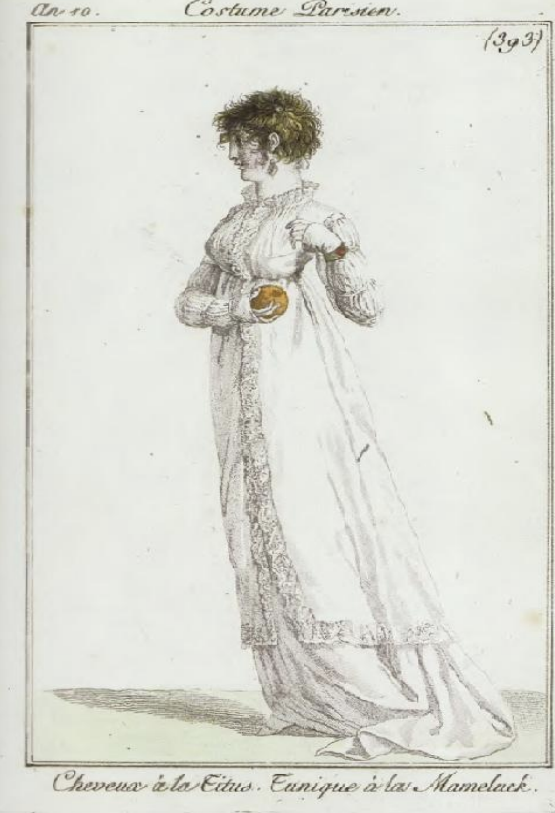
Whether it was meant as a political statement by the women who adopted this hairstyle or not, it became really popular among French women. Most of the paintings we see of the Titus cut are worn by the women who could afford portraits, but it was a very popular style for lower class women too. The hair trade was a lucrative business, and a lot of lower and working class women were forced into selling their hair due to economic pressures – this meant that the Titus cut was pretty accessible regardless of money. The Titus evolved over the 20 or so years that it was popular; it went from more messy, dishevelled and ‘masculine’ looking, to being finessed and decorated with flowers and bows. I wonder if this evolution was specifically because it was adopted by lower classes; perhaps it evolved as a way to differentiate upper class women to their lower class counterparts. There’s also the fact that shaving a women’s heads has historically been used as punishment due to hair was seen as a marker of femininity, without hair women were considered disfigured. There is a lot more to be said about the relationship between class, race and gender within the hair industry – it’s something that I imagine will come up in every post I make about hair because they are all so strongly interwoven.
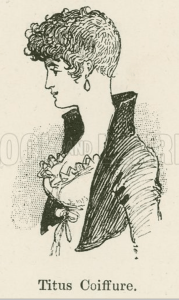
This hairstyle has also been given a different name: The Guillotine Haircut! It was named as such because during The Terrors (the period of mass executions of the French aristocrats – again, think Marie Antoinette), executioners would cut the hair of the soon to be executed so that the guillotine blade could smoothly cut through their neck. Ironically, there were thought to be many high society balls where people would dress up à la victime, meaning they would cut their hair short, go barefoot, and tie a ribbon round their neck to symbolise the guillotine. I say ‘ironically’ because it was those high society folk who were being publicly executed – it feels like when Black Mirror criticises Netflix while also airing on Netflix! There is not a huge amount of evidence to suggest that these balls actually took place, and instead they may be a more modern invention. However, while doing research for this, I came across these iconic Guillotine earrings which suggests a playfulness around The Terrors – these earrings do not have an official date but are thought to be from the Directoire Period (1795-99).

There seems to be some contrasting evidence out there about whether the majority of short haired women during this period were getting their haircut à la Titus or à la victime – were they getting their haircut as a political statement or as a form of dress up? I think the answer is probably that, like most things co-opted by fashion, it starts as a form of political activism but the image spreads further and faster than the message and so after a few years the message has been lost but the style remains.
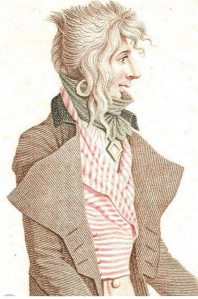
Carle Vernet . 1796
In a modern day setting, this haircut is not too dissimilar from some pixie, modern mod or Chelsea cuts, but what I think makes the Titus cut different is the layered texture throughout and the curly ‘spaniel ears’ or tresses that hang down the front. If I were to do this cut for a client, I would predominantly use a razor and style with powder and a clay or pomade (depending on the hair texture), which would give it a more messy, textured finish. Also, depending on the client’s natural hair texture, I might apply a perm to give it that extra boost of volume and to emphasise the ‘spaniel ears’.
This is a haircut I would absolutely love to do and so if you’re interested, either DM on Instagram, through the Contact Me form on this website, or leave it as a note when you book online.

Research:
- A Cultural History of Hair In The Age of Enlightenment edited by Margaret K. Powell and Joseph Roach
- Usurping Masculinity: The Gender Dynamics of the coiffure à la Titus in Revolutionary France by Jessica Larson
- Coiffure a la Titus by Shannon Selin
- The Guillotine Haircut by Amusing Planet
- The VERY Complicated History of Women with Short Hair by Kaz Rowe
- Usurping Masculinity: The Gender Dynamics of the coiffure à la Titus in Revolutionary France by Jessica Larson ↩︎
 BuzzGill
Leave a comment